Why Plain LLMs Fall Short in Enterprise Contexts
While Large Language Models possess broad general knowledge, they suffer from two major limitations in real-world business environments: cut-off knowledge dates and a lack of access to proprietary, private company documentation.
How RAG Bridges the Gap
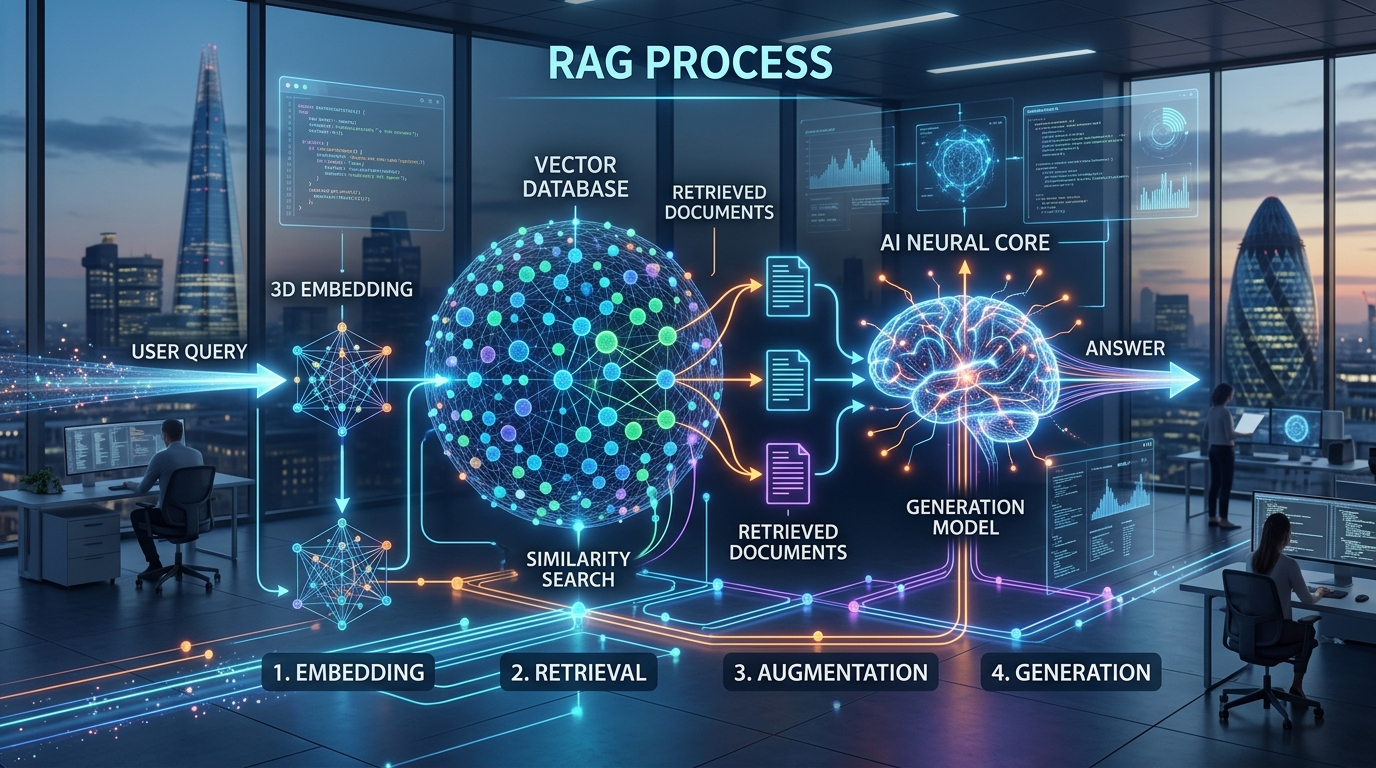
Retrieval-Augmented Generation (RAG) solves this by fetching relevant document chunks from an external knowledge store before generating a response. This grounds the model's answer in factual, verifiable source material.
The 3 Core Stages of a Modern RAG Pipeline
- Ingestion & Chunking: Breaking down PDFs, databases, and Notion pages into semantically coherent paragraphs.
- Vector Embedding & Indexing: Converting text chunks into high-dimensional vectors stored in databases like pgvector or Pinecone.
- Semantic Retrieval & Synthesis: Performing cosine-similarity search against user queries and supplying the retrieved context into the LLM prompt.
Best Practices for Production RAG
For optimal retrieval precision, top engineering teams implement hybrid search (combining dense semantic vectors with sparse BM25 keyword matching) and dynamic re-ranking models.