Artificial Intelligence has rapidly evolved from a futuristic concept into a practical tool that millions of people use every day. Among the most talked-about innovations are ChatGPT and AI Agents. While these terms are often used interchangeably, they represent two different levels of AI capability.
Understanding the difference between ChatGPT and AI Agents is becoming increasingly important for professionals, business leaders, and learners who want to stay ahead in an AI-driven world. Although both technologies are powered by advanced AI models, they are designed to solve different types of problems and offer different levels of autonomy.
ChatGPT is a conversational AI system designed to interact with users through natural language. It can answer questions, generate content, summarize information, assist with research, write code, brainstorm ideas, and support countless other tasks.
The key characteristic of ChatGPT is that it responds to prompts. A user provides an instruction, question, or request, and ChatGPT generates an output based on that input.
For example, a marketing professional might ask ChatGPT to write a social media campaign. A student might use it to explain a complex concept. A business owner could request ideas for improving customer engagement.
In each case, ChatGPT acts as an intelligent assistant waiting for instructions before taking action.
This makes ChatGPT incredibly powerful for productivity, creativity, and knowledge work. However, it still relies on human direction for every step of a process.
AI Agents represent the next evolution of artificial intelligence systems.
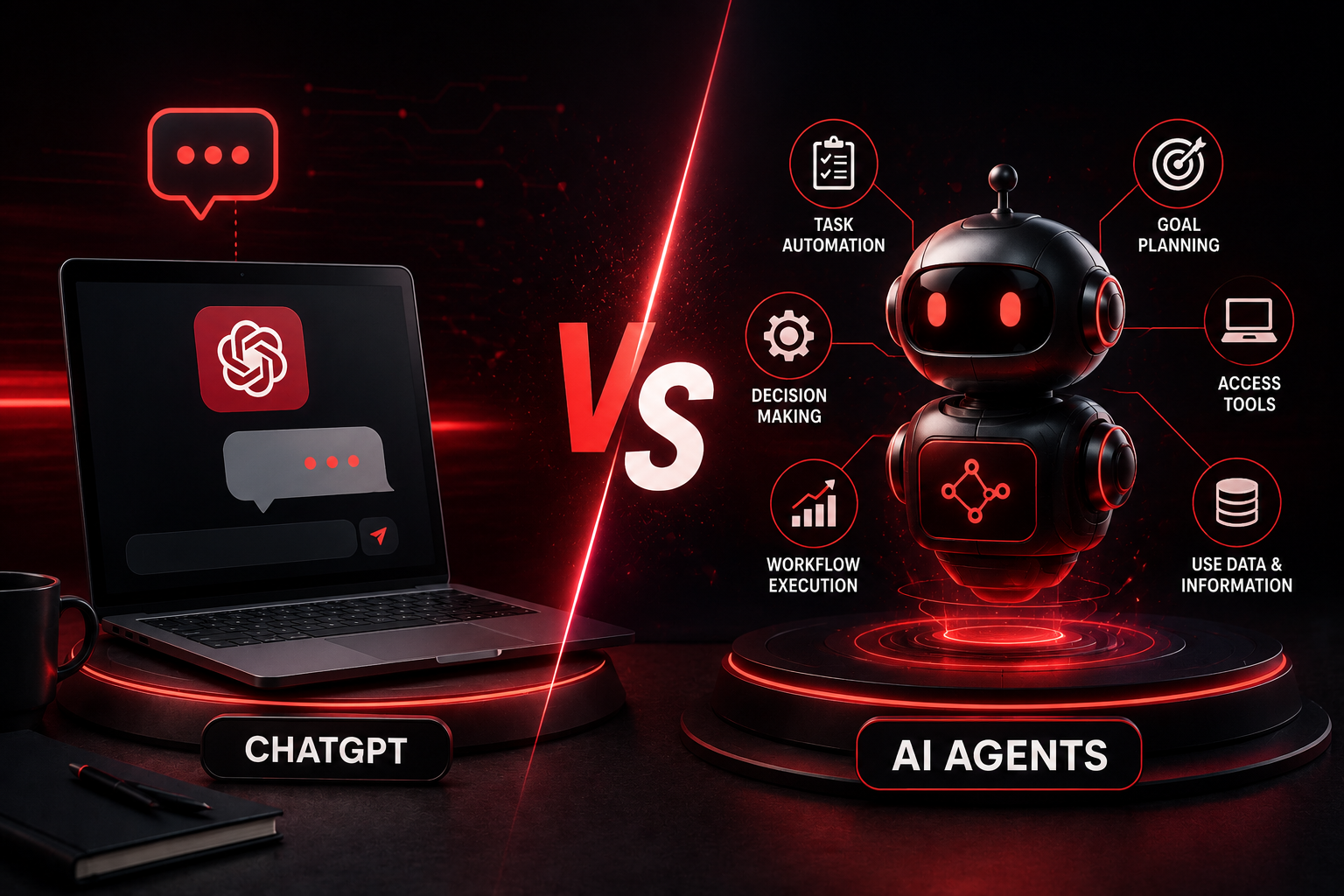
Unlike traditional AI chatbots that simply respond to prompts, AI Agents can perform tasks, make decisions, execute workflows, and interact with multiple tools with limited human intervention.
An AI Agent is designed around a goal rather than a single conversation.
Instead of asking an AI to complete one task at a time, a user can provide an objective, and the agent determines how to achieve that objective.
For example, imagine a company wants to generate weekly market research reports. ChatGPT could help create the report if prompted. An AI Agent, however, could automatically collect information from various sources, analyze trends, generate a report, and distribute it to stakeholders without requiring continuous instructions.
The difference is similar to hiring an assistant versus hiring a project coordinator. One responds to requests, while the other actively manages tasks to achieve an outcome.
The simplest way to understand the distinction is to think about autonomy.
ChatGPT is reactive. It waits for instructions and produces outputs based on those instructions.
AI Agents are proactive. They can plan actions, make decisions, use tools, and execute multiple steps to achieve a goal.
Both technologies are valuable, but they serve different purposes.
ChatGPT excels when users need support with thinking, writing, researching, learning, or generating ideas.
AI Agents excel when organizations want to automate workflows, reduce manual effort, and create systems that can operate independently.
Consider the process of planning a business conference.
Using ChatGPT, a user could ask for event ideas, marketing copy, attendee emails, social media content, and promotional strategies. ChatGPT would generate each output when requested.
Using an AI Agent, the process could be largely automated. The agent could monitor registrations, send reminder emails, update attendee lists, schedule communications, generate reports, and notify organizers of potential issues.
In both cases, AI is helping achieve the objective, but the level of automation is significantly different.
Organizations are increasingly looking beyond simple AI assistance and toward complete workflow automation.
Businesses want systems that can reduce repetitive work, improve efficiency, and enable teams to focus on higher-value activities.
AI Agents are particularly valuable because they can integrate with software platforms, databases, communication tools, customer relationship management systems, and business applications.
This ability allows them to perform tasks that previously required multiple employees or manual processes.
As a result, AI Agents are becoming one of the most important trends in enterprise AI adoption.
Not at all.
In fact, many AI Agents use large language models such as ChatGPT as their reasoning engine.
ChatGPT often serves as the intelligence behind an agent’s decision-making process, while additional systems enable the agent to take actions, access information, and interact with external tools.
Rather than replacing ChatGPT, AI Agents build upon its capabilities.
Think of ChatGPT as the brain that generates understanding and responses, while AI Agents combine that intelligence with memory, workflows, tools, and execution capabilities.
For professionals entering the AI space, understanding both technologies is increasingly important.
Learning how to effectively use ChatGPT can improve productivity, communication, content creation, research, and problem-solving capabilities.
Learning about AI Agents helps professionals understand automation, workflow design, business transformation, and the future of intelligent systems.
As organizations continue investing in AI, individuals who understand both conversational AI and autonomous agents will be well positioned for emerging opportunities.
The future of artificial intelligence is likely to involve a combination of both technologies.
ChatGPT and similar AI assistants will continue helping individuals think, learn, create, and work more efficiently.
AI Agents will increasingly automate complex processes, manage workflows, and support business operations at scale.
Together, these technologies are reshaping how organizations operate and how professionals interact with technology.
ChatGPT and AI Agents are related, but they are not the same thing.
ChatGPT is designed to assist through conversation and generate responses based on user input. AI Agents are designed to pursue objectives, make decisions, and execute tasks with greater autonomy.
Understanding this distinction is essential for anyone looking to build AI skills, adopt AI within their organization, or prepare for the future of work.
As AI continues to evolve, the most successful professionals will be those who understand not only how to use AI tools but also how to design systems that leverage AI to create meaningful outcomes.
The good news is that developing AI skills is more accessible than ever. Professionals can start with foundational concepts before progressing into specialized areas such as prompt engineering, automation, AI agents, machine learning, or business applications.
A structured learning path that combines theoretical understanding with practical application is often the most effective way to build confidence and demonstrate competence.
The demand for AI skills is expected to continue growing throughout 2026 and beyond. Employers are not simply looking for AI experts; they are looking for professionals who can effectively apply AI to solve real-world challenges.
By developing skills such as prompt engineering, AI literacy, automation, data analysis, AI agent development, and responsible AI practices, individuals can position themselves for success in an evolving job market.
The future workplace will increasingly reward those who understand how to work with AI rather than compete against it. Investing in AI education today can help create new career opportunities, improve professional performance, and prepare you for the next generation of work.